Stocks & Fonds · Maison III
Why Stock Is Never Boiled
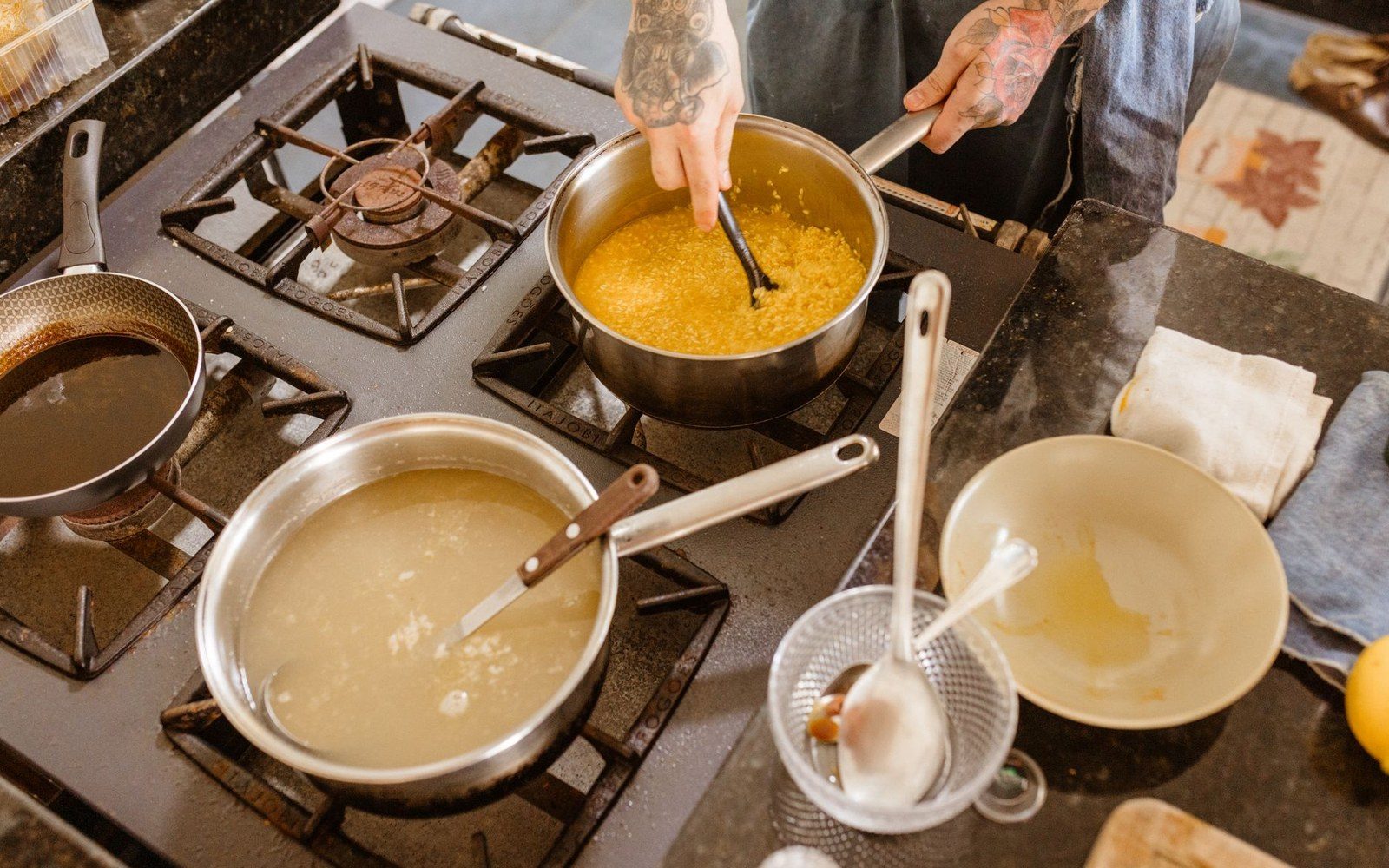
A rolling boil will ruin a stock before it has properly started. The reason is physical, not superstitious.
What the heat is actually doing
When you submerge bones in cold water and raise the temperature gradually, two things rise to the surface in the early stages: grey-brown foam and a slick of fat. The foam is coagulated protein — largely myoglobin and albumin — that has denatured and clumped. The fat is rendered from the marrow and any connective tissue still clinging to the bone. At this point, everything is still separable. Skim the foam, and it's gone. The fat sits in a distinct layer. The liquid beneath can still become something clear and clean.
Apply a full boil and that separation ends. Vigorous agitation mechanically breaks the fat droplets into tiny particles and beats them into suspension alongside the remaining protein fragments. This is emulsification by brute force: the turbulence acts on fat and water the same way a whisk does when you're making a vinaigrette. What you get is a permanently cloudy liquid with a flat, woolly flavour. The cloudiness isn't cosmetic — it signals that fat and denatured protein are now dispersed through the stock rather than removed from it. That fat coats the palate and mutes whatever clean flavour the bones and aromatics were contributing.
What a tremble achieves instead
The classical instruction — frémir in French, to shiver or tremble — means keeping the liquid just below a full simmer: a bubble breaking the surface every few seconds, not a steady rolling churn. At this temperature, collagen in the connective tissue and cartilage has time to convert slowly into gelatin, which is what gives a finished stock its body and its characteristic lip-coating quality when reduced. A boil doesn't speed that process usefully; it just destroys the clarity.
There is also a purely practical reason to keep the heat low. Evaporation at a boil is rapid and uneven, which concentrates the stock too fast and can push bitter or acrid notes from the marrow forward before the collagen has fully dissolved. A long, slow extraction — several hours at a bare tremble — pulls the gelatin out gradually and allows the liquid to clarify naturally as proteins that didn't foam off in the initial skim continue to coagulate and sink rather than being held in suspension by turbulence.
This is why white stock and brown stock are both held at the same low temperature despite their different flavour profiles: the physics don't change just because the bones were roasted first.
| Emulsification | Fat broken into particles small enough to stay suspended; a boil causes it mechanically, through turbulence |
| Frémir | To shiver or tremble — just below a simmer, a bubble breaking every few seconds |
| Collagen to gelatin | The slow conversion that gives stock its body; not usefully accelerated by boiling |
| Myoglobin and albumin | The soluble proteins that foam off in the early skim — or disperse forever if boiled |
The cold-water start and the skim
Starting in cold water rather than hot is not a ritual — it's the mechanism. Cold water allows soluble proteins to dissolve out of the bones gradually and rise slowly to the surface, where they can be skimmed cleanly before they coagulate into the body of the liquid. Hot water shocks the exterior of the bone, seizing those proteins in place and trapping them. Some cooks go further and blanch bones briefly before the main stock, discarding that first grey water entirely; the principle is the same.
Once you've skimmed, reduce the heat until the surface barely moves and leave it alone. The stock will clarify itself. After straining and chilling, the fat solidifies at the surface and lifts off in a single layer — a final separation that a boiled stock will never allow, because its fat is already dispersed past the point of removal.
The whole logic of stock-making depends on keeping things separable for as long as possible. A boil collapses all the distinctions at once. A tremble maintains them until you choose to.
Continue in the house