The Methods · Maison I
Confit and Braise Are Not the Same Wet Heat
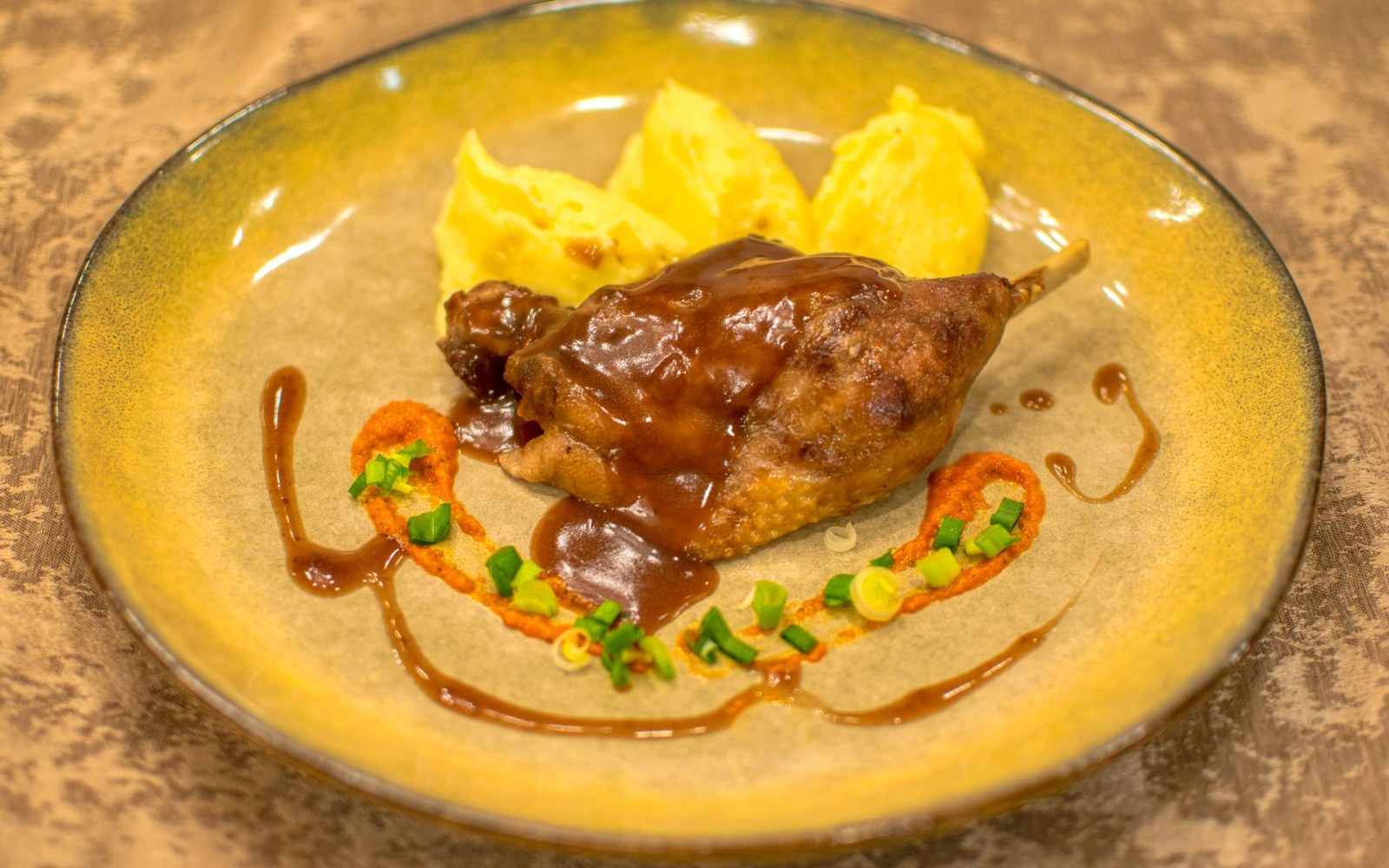
Both methods submerge food in a warm liquid for a long time. That is where the resemblance ends.
The Medium Is the Point
A braise surrounds food in water-based liquid — stock, wine, the natural juices the meat releases — and relies on that liquid to carry heat, dissolve collagen, and build a sauce. Water boils at 100°C and a braise runs well below that, but the liquid still moves, still circulates, and it is always pulling soluble compounds out of the meat: gelatin, flavour molecules, colour. The exchange runs in both directions, which is why the braising liquid becomes as important as the meat itself.
Confit replaces all of that water with fat. Duck legs, gizzards, pork belly — the classic subjects — are packed with salt for some hours, rinsed, then submerged entirely in their own rendered fat and held at a low temperature, traditionally in a pot over the lowest possible flame or, in the farmhouse original, in an oven barely ticking. The fat never exceeds around 85–90°C in practice, often less. That ceiling matters enormously.
What Fat Does That Water Cannot
Fat and water are not interchangeable heat-transfer media. Water is a polar solvent: it dissolves and carries away water-soluble proteins, pigments and flavour compounds. Fat carries none of those things. It is a non-polar medium, chemically indifferent to the muscle tissue around it, which means the meat is insulated from loss. Moisture inside the muscle — and duck legs contain a great deal of it — cannot easily escape into fat. The result is that confit meat stays remarkably succulent despite cooking for two or three hours, because the internal moisture has nowhere to go.
There is a second consequence. Because fat conducts heat more slowly than water and the temperature is held so low, the proteins in the muscle fibres denature gently and over a long period. Collagen converts to gelatin at around 70–75°C; held there without the aggressive turbulence of even a gentle braise, the connective tissue softens without the muscle fibres seizing and squeezing dry. This is why properly made confit pulls apart in long, moist fibres rather than the more unified, gelatinous texture a braise produces.
| La braise | Le confit | |
|---|---|---|
| The medium | Water-based — stock, wine, the meat’s own juices | Rendered fat |
| The exchange | Two-way: the liquid pulls gelatin, flavour and colour out of the meat | One-way: fat gives nothing and takes nothing away |
| The texture | Unified, gelatinous, yielding | Long, moist fibres that pull apart |
| Afterwards | Eaten promptly, like any cooked wet food | Traditionally stored under its own fat — confire, to preserve |
The salt cure applied before the fat bath is not optional decoration. It draws surface moisture out of the meat and begins a mild curing process — seasoning the flesh from within, firming the outer tissue slightly so it holds its shape during the long bath. The pre-salting also means the meat goes into the fat already seasoned, so nothing needs to pass between the two during cooking.
Preservation, Not Coincidence
The French farmhouse tradition of confit was never about flavour alone. Stored under its own fat in a sealed crock, confit survives for weeks in a cool larder — the fat excludes oxygen and forms a physical barrier against bacterial contamination. The word itself comes from confire, to preserve. Braised meat makes no such claim: it should be eaten promptly or refrigerated like any cooked, wet food.
This preservation logic shaped the method's parameters. The relatively low temperature, the completeness of the fat covering, the preliminary salting — all of these served storage as much as taste. Modern cooks who confit duck in a controlled oven at precisely the same temperature every time are executing the same logic, even if the crock in the cold cellar is no longer part of the plan.
Preserving meat under fat touches real food-safety ground — curing, temperatures, storage. This page explains the cooking; if you mean to store a confit rather than eat it, take the procedure from a dedicated preservation reference, not an essay.
The practical lesson is simple: choose your medium with intention. A braise builds a sauce and enriches a liquid. A confit protects the meat from loss, cooking it slowly in a medium that gives nothing and takes nothing away.
Continue in the house