Sauces · Maison II
Reduction Is Not the Same as Thickening
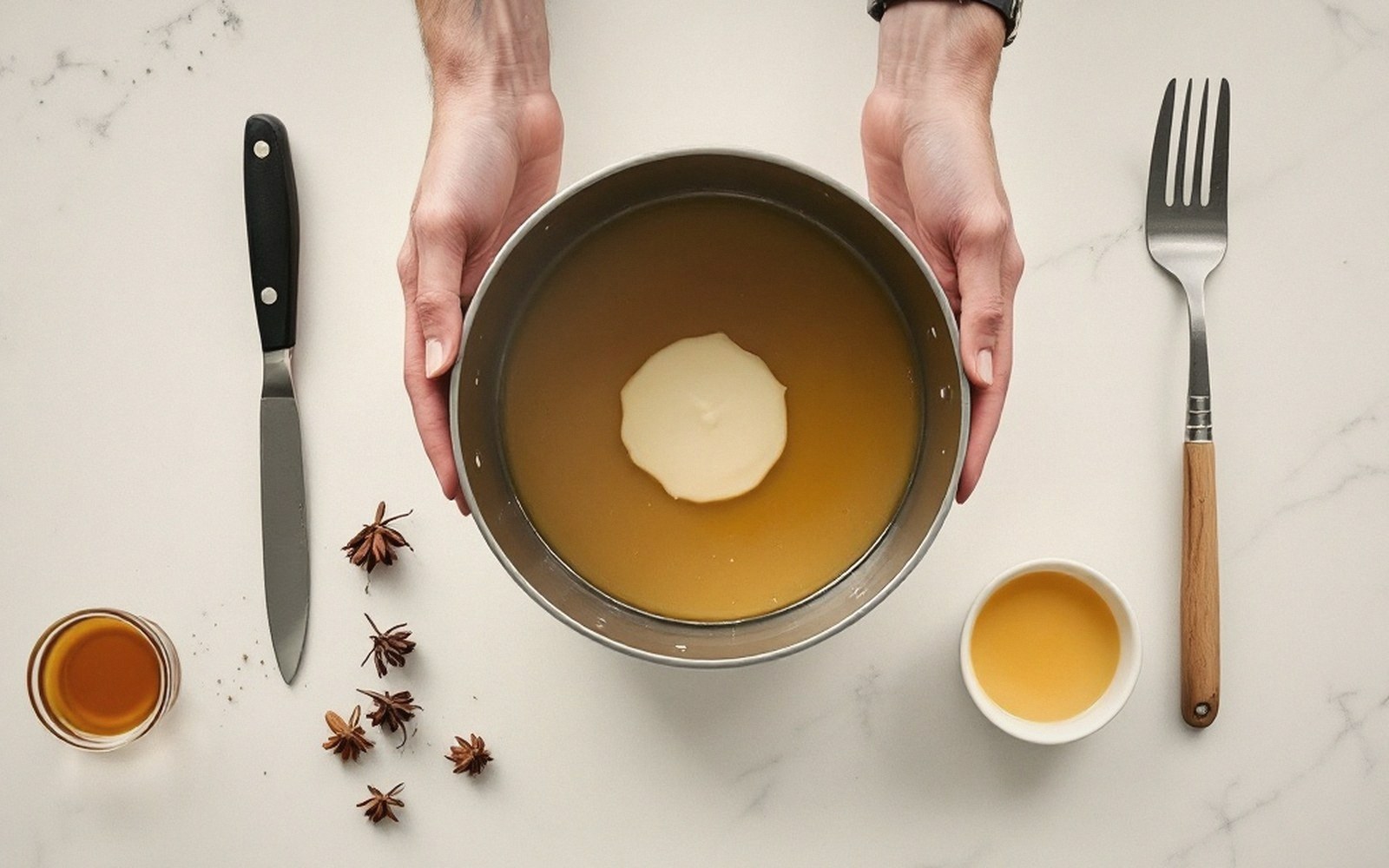
Two operations, one pot, completely different outcomes — and confusing them is where most sauce failures begin.
The Distinction That Changes Everything
Reduction and thickening are both ways to make a liquid less watery. The resemblance ends there.
When you reduce a sauce, you drive off water through evaporation. What remains is more concentrated — the sugars, salts, glutamates, and dissolved proteins that were always in the liquid are now present in a smaller volume. The sauce feels substantial because flavour molecules are packed more tightly, and because the liquid's own dissolved solids, particularly gelatin from a well-made stock, become more prominent. The texture is glossy, clean, and alive on the palate. It moves in the pan like something that has authority.
When you thicken with starch — a roux, a slurry, a beurre manié — something structurally different happens. The starch granules hydrate, swell, and gelatinise, creating a matrix that physically traps water inside it. The volume barely changes. The flavour does not concentrate. What you have made is denser, not more flavourful, and the texture is fundamentally different: starch thickening produces a sauce that coats rather than one that clings.
Neither result is wrong. They are answers to different questions.
| Reduction | Starch thickening | |
|---|---|---|
| What happens | Water leaves by evaporation | Starch traps water in a gel matrix |
| Flavour | Concentrates | Unchanged — density without intensity |
| Body comes from | Dissolved gelatin and solids | Gelatinised starch |
| The look | Glossy; moves freely; clings | Coats, with a slightly matte, opaque sheen |
Why Conflating Them Fails
The trouble starts when a cook reaches for starch because a sauce is thin, when the real problem is that the sauce is under-reduced and under-flavoured. Adding flour or cornstarch to a weak fond simply traps the weakness inside a gel. The sauce becomes thick and bland — the worst outcome, because it now looks finished and tastes of nothing. The starch has provided cover for a failure that should have been solved at the reduction stage.
The reverse error also occurs. Attempting to reduce a starch-thickened sauce to concentrate it will break the sauce: the starch burns on the base of the pan before the water evaporates, or the gelatinised matrix tightens past the point of palatability into something gluey. Starch-thickened sauces are largely heat-stable in service, but they do not respond to further reduction as an improvement tool.
The correct order of operations is this: reduce first, to the flavour and consistency a good stock will support, then decide whether starch is appropriate at all. In a classical demi-glace, reduction alone provides body — the gelatin dissolved from bones and the long concentration of the fond do the work. Starch enters the picture only in specific preparations, and always as a deliberate choice with a specific purpose, not as a rescue.
The visual test: a reduced sauce moves in the pan like something with authority and looks glossy; a starch-thickened sauce coats the spoon with a slightly matte, more opaque sheen.
Understanding this is the difference between a cook who follows a sauce recipe and one who knows what the sauce is supposed to become.
Continue in the house